August 27, 2026
My Home AI Setup Costs More Than Four Claude Subscriptions
I wanted a system where my whole household could use the best AI facilities available, without our data ever leaving our premises. That was the goal from the start — not cutting costs, not avoiding subscriptions, just genuine control over where the data actually lives.
Last weekend I rolled out the pilot — my own server, my own storage, nothing leaving infrastructure I controlled. No third-party training on conversations, no public exposure. Then a long call with a friend who does this professionally left us at the same uncomfortable conclusion: competing with a frontier model from a household setup is genuinely hard, and worth being honest about before anyone tries this expecting a like-for-like replacement.
Two servers, one private network
Two providers, split by role. A DigitalOcean droplet in Sydney — no GPU, cheap, always on — runs the interface and storage. A RunPod Serverless endpoint handles the GPU-backed model. Tailscale connects household devices to the droplet with no public entry point — confirmed by testing that the public IP times out while the Tailscale address connects cleanly.
The rule I wanted from the start was simple: if nobody's using it, stop the pod straight away, and bring it back the moment someone needs it again. No idle GPU sitting there burning money between sessions.
Storage lives on a separate Volume, not the droplet itself, so data survives even if the server gets replaced. And for the first few weeks, I kept the whole thing deliberately off the radar — nowhere findable unless you already knew exactly where to look. Wider access, if it ever happens, is a later decision, not this one.
61 seconds, then 1.4
The first test used a small CPU-only model, since the base machine had no GPU. First response: 61 seconds — proof the pipeline worked, and far too slow to actually use.
Once the RunPod GPU endpoint was connected, the same request came back in 1.41 seconds. Roughly 40 times faster — the difference between "technically works" and "actually usable."
Getting there wasn't clean. The GPU worker crashed on every startup with a memory allocation error, traced to a default concurrency setting built for hundreds of users, not a household of three or four. Dropping that one number fixed it. Small bug, real afternoon lost.
Four subscriptions would have been cheaper
The comparison I was actually working from wasn't some averaged industry number. We run a team account — one person on Fable 5 for heavier work, the rest of us on Sonnet — and most weeks everyone stays comfortably within limits. Some weeks, one person runs about $1,000 over in extra credit. That's the real baseline I was building against, not a flat per-seat estimate.
For a simpler comparison, here's what that actually looks like against a straightforward alternative:
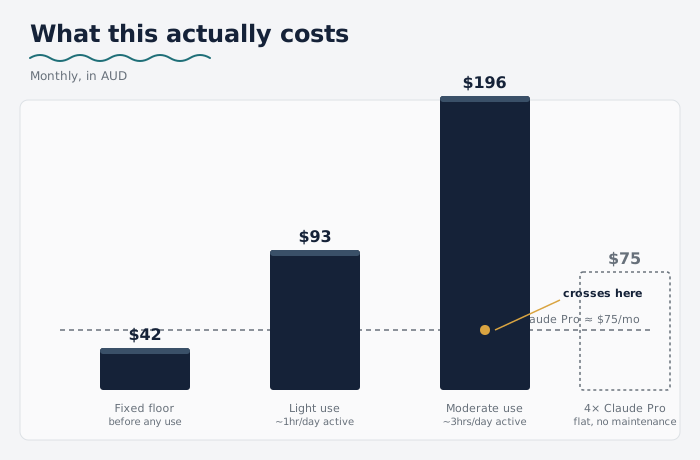
Four Claude Pro subscriptions run about $75 AUD a month combined. At moderate usage, this setup costs more than double that — for infrastructure I maintain myself, with none of the safety tooling or integrated capabilities a commercial product includes by default.
Asking a different question entirely
Partway through, I wrote down exactly what I was feeling: I just feel like I am building towards something very basic and it doesn't replace my privacy concern. That doubt is what led to the conversation that actually reframed the whole project.
I laid this out to a friend who builds this professionally, expecting him to spot an optimisation that would close the gap. He didn't. Instead: I was measuring the wrong thing. Matching frontier capability takes frontier-scale compute no household GPU touches. The question was never "can this replace it." It was "what's this actually good for."
That reframe made the answer clear. This setup is genuinely good at routine chat, drafting, search-grounded lookups, cataloguing documents, well-scoped coding tasks — the everyday, privacy-sensitive work that doesn't need frontier reasoning. It's not built for complex multi-step reasoning, tools working together, or generating documents and slides. Forcing it into that role would have been the actual mistake.
Complement, not competitor
The gap between "privacy achieved" and "capability achieved" is real. This project solved the first without touching the second. Self-hosting doesn't remove cost, it just changes what you're paying — subscription fee traded for engineering time. I spent part of this week debugging a self-hosted search tool that kept returning a persistent 403 error no matter what I tried. Several rounds of config fixes later — including recovering from a syntax error I'd introduced myself along the way — the actual cause turned out to be a missing header requirement buried in the request handling, not the bot-detection setting I'd assumed it was. That's not a one-off. That's what the ongoing cost of "control" looks like.
This isn't a Claude replacement, and I'm glad I stopped trying to make it one. It's a complement — the routine, privacy-sensitive layer next to the frontier tool, not competing with it.
That's the technical side. The conversation that followed went somewhere heavier — I've written that part up separately, since it didn't end as neatly as this.