August 24, 2026
Reading Fire Season Like a Forecast
In the summer of 2019/20 I was working at Target Australia. All of a sudden, the intensity of news around bushfires around Australia increased. We started hearing things like 500 million animals had been lost. We heard that maybe there was over 50 billion in loss to the economy. We would see images and videos of blazes running through towns all over our feeds and news channels. For over a month, the blue skies of Australia that I had fallen in love with were covered with smoke. The smoke was so bad that even the sunset in Buenos Aires, Argentina reportedly turned red.
During summer, sunset is close to 9pm. As a runner, that's the best time to go for a run after work — warm, still light, the day still feels open. That season I couldn't. The air quality had dropped so much that Melbourne started looking like Lahore on its worst smog days.
What I didn't think about, watching this from a desk in retail, was what actually has to happen for a fire truck to show up. It arriving on time isn't just luck. It's the end of a supply chain — hose, PPE, vehicles, fuel, aircraft contracts, spare parts, all procured and positioned months or years before a fire starts. I'd spent years by then untangling supply chains for a living, and as a bit of a hobby too. But I'd never once asked what the supply chain behind a fire brigade looked like. Those fires got me asking: what does it actually look like, and when does the work of building it start?
What I found was a pattern I recognised straight away — not because I know anything about firefighting, but because I've spent over a decade managing demand that spikes without warning, and building the buffer to survive it.
When demand stops being predictable
A business can survive high demand. What breaks it is demand that's both big and unpredictable, because unpredictability is what defeats forecasting.
Fire season is becoming exactly that. Recent research covering 44 years of global wildfire data found 43 per cent of all major bushfire disasters since 1980 happened in just the last decade. Not marginally worse — a demand curve reshaping itself.
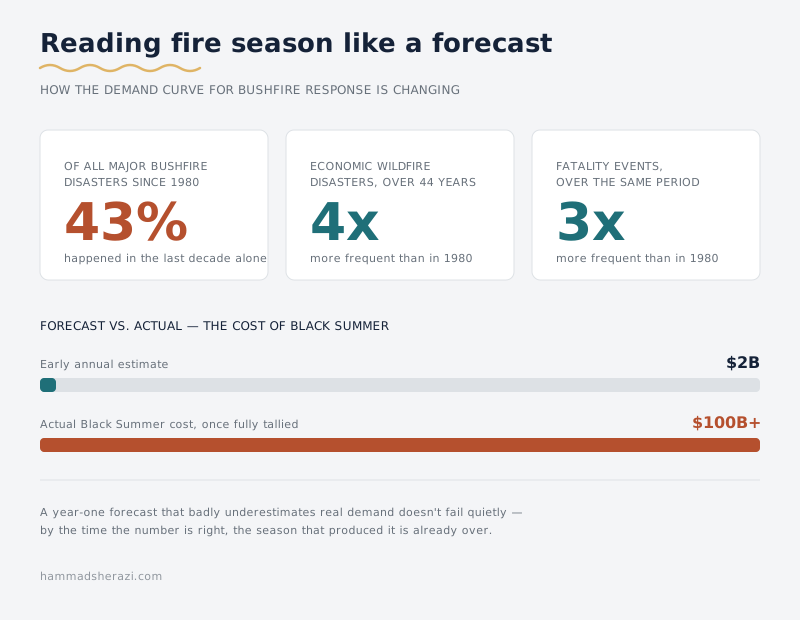
Early estimates put the yearly cost of bushfires to the Australian economy at around $2 billion. The real cost of Black Summer, once fully tallied, came in well above $100 billion. That's what a bad forecast looks like — you get the real number long after the season that produced it is over.
The question isn't whether anyone can predict fire season perfectly. It's whether the system is built to survive being wrong.
Buffer built after the fact
Surviving unpredictable demand isn't about forecasting it right. It's about building buffer before you need it. I learned that early — too little buffer and a spike becomes a stockout, too much and you're burning cash on shelf space you don't need. The real skill is deciding ahead of time what kind of spike your system can actually take.
Black Summer showed what happens without that buffer — weeks into the crisis, NSW temporarily doubled the tender threshold for councils doing bushfire recovery work, from $250,000 to $500,000, the same move a retailer makes when they fast-track a supplier mid-stockout instead of before one.
I don't think that's a failure to plan. It's a question of when the planning happens. Deciding on safety stock in July, before the season starts, is a different job to making the same call in January with fires already burning. One is planning. The other is triage.
The same rhythm for everything
I went looking for when this planning actually starts. Fire Rescue Victoria publishes a forward procurement plan — everything they're planning to buy over the year, by quarter. It's genuinely useful. It's also revealing in a way I don't think it means to be.
On that list, a panel for firefighting hose sits next to gym equipment maintenance. A replacement firefighting vessel sits next to pest control and air conditioning servicing. Everything runs on the same quarterly rhythm, no matter what it actually is.
I recognise that. Not everything in a warehouse deserves the same attention — some categories move the numbers and some don't. That's easy to lose sight of the longer a system runs on one rhythm, because the rhythm starts to feel like the plan itself. But the conditions that made that rhythm reasonable are shifting. If disasters keep getting more frequent and less predictable, a quarterly cadence built for steady-state buying won't hold. Readiness will need to move at the same pace as the risk — which means building agility into the cadence, not just adding more lines to the same list.
A good idea with nowhere to sit
The clearest example of this wasn't in Victoria. It was the ACT.
In 2019, the ACT's Emergency Services Agency partnered with a manufacturer to build one of the world's first electric fire trucks. A good idea on paper — less diesel exposure for crews, lower emissions, a chance to be first in the country on something real. A dedicated business case went in for around $2.3 million to fund it properly.
Then COVID hit, budgets got disrupted, and that funding never came through.
Instead of restarting the process, the truck got folded into a routine tender for ordinary diesel pumpers that was already underway. The manufacturer barely mentioned the hybrid concept in its response. The report assessing value for money didn't mention it at all. The truck still got added to the contract months later, at roughly 87% more than a standard unit, without ever going through the same evaluation the diesel trucks did.
I don't think that's bad faith. I think it's what happens when a new idea loses its own lane and gets carried along inside a process that was never built to judge it. A routine reorder and a new product launch aren't the same decision. Running them through the same gate doesn't make the second one simpler — it just makes it invisible to the checks meant to catch it.
Rosenbauer wasn't the only manufacturer with a truck like this. Pierce, the largest fire truck maker in North America, had its own electric truck in service around the same time. Oshkosh, Pierce's parent, has since electrified its airport rescue vehicles too. This wasn't one company pitching a moonshot to a buyer who didn't know better. It was a real moment in the industry, with more than one option on the table.
I'm not saying anyone picked wrong. I don't know what else was considered. I say it because it changes the story a little — this wasn't a case of nobody having answers. It was a case of a good idea turning up at the same time as other good ideas, and none of them getting the proper evaluation any of them deserved.
What I keep coming back to
I don't know what fire season looks like ten years from now, except that it's probably not getting simpler. I don't have a fix for any of this — I'm not inside these organisations, and I don't know what's actually workable at that scale. What I do know is that I recognise the pattern. A buffer built after the fact instead of before it. A new idea losing its own lane. A rhythm that made sense once, still running on its own, past the point where anyone's checked if it still does.
I don't know if anyone inside CFA or FRV or the ACT thinks about it in these terms. Maybe they do and I've just never seen it written down. Either way, it's the same problem I spent years working on with a completely different product on the shelf — and I don't think that's a coincidence.